
With fertilizer, too much and too little both fail
More fertilizer does not mean more growth. Plants can only take up so much, and whatever is left over becomes food for algae. Dose too little and growth simply stops. The target is always "just enough".
- Too little → stalled growth, holes in leaves, fading color, older leaves melting.
- Too much → plants can't use it all, and the surplus fuels an algae outbreak.
Know the nutrients — and the signs one is missing
Plants need the macronutrients nitrogen (N), phosphorus (P) and potassium (K), plus iron and other micronutrients. Which one is short usually shows up in the leaves (general guidance):
- Older (lower) leaves yellowing → often a nitrogen (N) shortage.
- Pinholes in leaves, edges dying back → often a potassium (K) shortage.
- New (top) growth pale or yellow → often iron / micronutrient shortage.
Symptoms overlap, so read them as a tendency, not a diagnosis, and adjust in small steps.
Setting the amount: dose per volume of water
Most bottled liquid fertilizers state a dose as "X mL per Y litres (or gallons)". So all you really need is your tank's water volume and that ratio.
- Work out your actual water volume (net of substrate, hardscape and displacement), not the tank's rated size.
- Start below the label dose and increase as the plants respond. Adding more is easy; you can't take it back out.
- Dry-salt / DIY dosing (such as the EI method) follows the same idea — you're still deciding "how much per volume of water".
Frequency: think of it together with light and CO₂
Frequency depends on the products and how fast the tank is growing, but the usual rhythm is "a small dose daily" or "a few times a week after a water change".
- More light and CO₂ = faster growth and faster uptake → the tank needs more fertilizer to keep pace.
- Heavy dosing in a low-light, no-CO₂ tank tends to go unused and feed algae instead. Light, CO₂ and ferts have to balance.
- A water change resets nutrients in the column, so dosing right after a water change makes an easy, repeatable schedule.
How to avoid feeding algae
- Watch the plants, not just the numbers. If they're growing well, the current dose is enough — don't push it higher.
- Algae showing up? Revisit ferts or light first. Ease off the dose, shorten the photoperiod — and remember a water change is the most reliable reset.
- Records reveal cause and effect. Logging what you dosed and when makes patterns like "algae appeared after I raised the dose" or "it calmed down after a water change" obvious.
A free app that does the dosing math and keeps the log
Calculating each product's dose every time — and logging doses and water parameters by hand — gets tedious fast. To make that lighter, I built and published a free app, Aquarium Fertilizer Calculator (a GRAMSHIFT project).
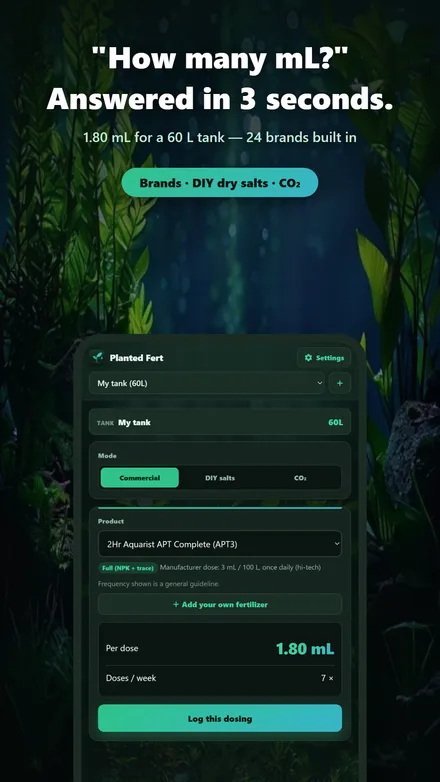
- 🧪 Pick the fertilizer you use, enter your water volume, and it works out the per-dose amount — from bottled liquids to dry-salt DIY (EI presets).
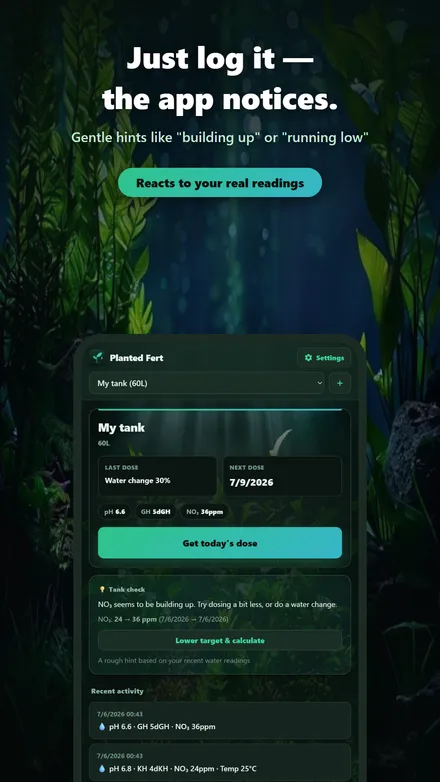
- 📈 Log water parameters, dosing and water changes and see them on a graph — "what I added, what I changed, what happened" at a glance.
- 💡 As your log builds up, the app notices how the tank is trending and gently suggests easing the dose up or down.
- 📷 A growth album (photo journal) keeps your scape's history. Works offline; your data stays on your device.
Calculations and suggestions are guidance only. Because plants respond to light, CO₂, livestock and water, let the tank be the final judge. Not for treating fish disease.
Summary
- Too much feeds algae, too little stalls plants — aim for "just enough".
- Shortages show in the leaves; read them as a tendency and adjust slowly.
- Amount = water volume × the product's dose ratio. Start low, work up.
- Match frequency to light and CO₂; dosing after a water change makes an easy schedule.
- Let an app handle the math and the log — records also make algae causes visible.