
Step 1: the volume of the mold
Measure the inside of the mold: the space the resin fills, not the outside of the silicone. For round shapes, r is half the diameter. Then use the formula for its shape:
| Mold shape | Volume | Example | Cubic inches | ml | fl oz | Part A + Part B at 1:1 by volume, +10% (fl oz) |
|---|---|---|---|---|---|---|
| Box or square coaster | L × W × D | 4 × 4 × 1/2 in | 8.00 | 131.1 | 4.43 | 2.44 + 2.44 |
| Round coaster or cylinder | 3.1416 × r² × D | 4 in across, 1/2 in deep | 6.28 | 103.0 | 3.48 | 1.91 + 1.91 |
| Ring (round with a hole) | 3.1416 × (R² − r²) × D | 4 in across, 2 in hole, 1/2 in deep | 4.71 | 77.2 | 2.61 | 1.44 + 1.44 |
| Dome (half sphere) | 2.0944 × r³ | 3 1/2 in across | 11.22 | 183.9 | 6.22 | 3.42 + 3.42 |
| Sphere | 4.1888 × r³ | 3 in across | 14.14 | 231.7 | 7.83 | 4.31 + 4.31 |
| Cone | 1.0472 × r² × H | 3 in across, 4 in tall | 9.42 | 154.4 | 5.22 | 2.87 + 2.87 |
The examples use inches. To convert: cubic inches × 16.39 = ml, and ml ÷ 29.57 = fl oz.
In metric it is simpler, because 1 cm³ is 1 ml: a mold 10 × 10 × 1 cm holds 100 ml. With 10% extra and a 1:1 resin, that is 55 ml of Part A and 55 ml of Part B.
If you are filling several cavities, add their volumes together before you add the extra.
Step 2: add a little extra for the cup
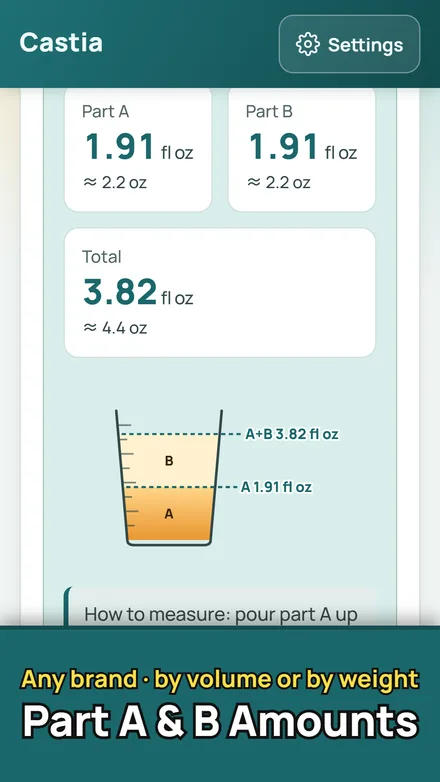
Some mixed resin always stays on the cup wall and the stir stick, so mix a little more than the mold holds. This guide uses 10%: for the 4 in mold, 3.48 × 1.1 = 3.828 fl oz, which you measure as 1.91 + 1.91 = 3.82 fl oz, each part rounded to 0.01 fl oz the way the app shows it. For a tiny pour, a fixed amount is lost on the stick whatever the size, so the extra matters more there.
Step 3: split it by the mix ratio, by volume or by weight
Your label gives the ratio and says whether it is by volume (you measure with cup marks) or by weight (you measure on a scale). Use it exactly as written:
- 1:1 by volume: half and half. 110 ml of mixed resin is 55 ml of A and 55 ml of B.
- 2:1 by volume: two thirds A, one third B. 110 ml is 73.3 ml of A and 36.7 ml of B.
- Any other ratio: Part A = resin × A ÷ (A + B). For 3:1, A is three quarters of the mix.
Why 1:1 by volume is not 1:1 by weight
Part A and Part B usually weigh different amounts per ml, so a ratio by volume and a ratio by weight are different numbers. You can convert between them with the density of each part, which is on the product's technical data sheet. With example densities of 1.15 g/ml for A and 0.95 g/ml for B:
- A resin mixed 1:1 by volume is 100:82.6 by weight (B per 100 of A = 100 × 0.95 ÷ 1.15).
- A resin mixed 100:45 by weight is 100:54.5 by volume (B per 100 of A = 100 × (45 ÷ 0.95) ÷ (100 ÷ 1.15)).
- To fill 100 ml with that 100:45-by-weight resin, weigh 74.4 g of A and 33.5 g of B (107.9 g in all).
If you only know the density of the mixed resin, multiply: weight = volume × density. At 1.1 g/ml, 110 ml of mixed resin weighs 121 g, and the 4 in mold's 3.82 fl oz weighs about 4.4 oz (124.3 g). That is a good estimate, but the exact split by weight needs both densities.
Flood coats: tabletops, trays and paintings
For a coat poured over a surface, the volume is area × thickness. The thickness per coat comes from your product's instructions; 1/8 in (about 3 mm) is used here as the example.
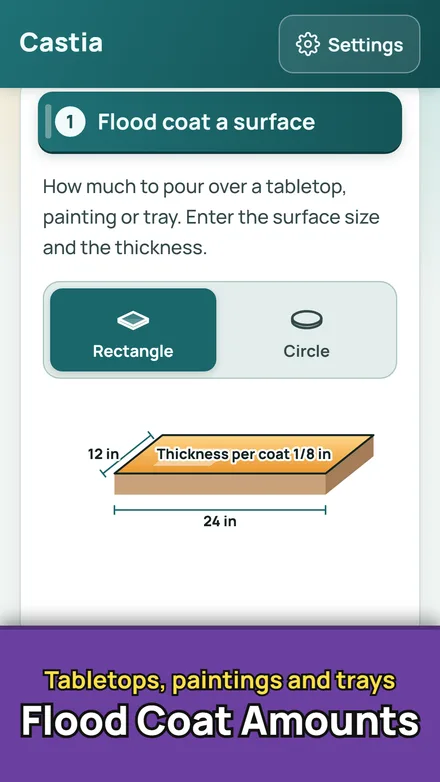
- Area. A tray 24 × 12 in is 288 sq in.
- Volume. 288 × 1/8 in = 36 cubic inches, which is 19.95 fl oz (590 ml).
- Drips over the edges. If the resin runs down 3/4 in sides, add the perimeter × the side height × the thickness: 72 in × 3/4 in × 1/8 in = 6.75 cubic inches more, for 23.69 fl oz (701 ml) in all.
- Extra and ratio. With 10% extra and a 1:1-by-volume resin: 13.03 fl oz of A and 13.03 fl oz of B (26.06 fl oz mixed).
In metric: a 60 × 40 cm top at 3 mm is 2,400 cm² × 0.3 cm = 720 ml per coat. For a round top, the area is 3.1416 × radius².
River tables: count only the river
Measure the gap between the wood, not the whole slab: length × average width × depth. Take the width at several points along the river and average them, because live edges wander.
Example. A river 48 in long, 6 in wide on average and 1 in deep is 288 cubic inches: 159.6 fl oz, about 1.25 gallons (4.72 liters), before the extra.
How many pours. Deep pours make heat as they cure, so each product has a maximum depth per pour on its label. If yours says 1/2 in, the 1 in river takes 2 pours of 1/2 in each. Divide the depth by the maximum and round up.
Seal coats on the wood and any leaks in the form come on top of the river volume, so keep some resin in reserve.
Molds you can't measure: the water method
For shapes with curves or detail, fill the mold with water and weigh the water. 1 g of water is about 1 ml (water at room temperature is 0.998 g/ml), so 150 g of water means the mold holds 150.3 ml. Use that volume as above, and dry the mold completely before the resin goes in.
Mistakes that leave you short or with too much
- Measuring the outside of the mold. Silicone walls are thick. Use the inside size, or the water method.
- Using the diameter as the radius. For round shapes r is half the diameter. Using 4 instead of 2 gives four times the resin.
- Weighing a ratio that is by volume (or measuring by cup a ratio that is by weight). Follow the label, or convert with both densities as above.
- Mixing with no extra. The resin left on the cup and stick leaves the mold short.
- Pouring deeper than the label allows. Split a deep pour into layers.
- Mixing far more than you can pour in time. Mixed resin keeps working only for its pot life, which is on the label. For big jobs, mix in batches.
Do it at the bench: Castia
Castia is a free Android app that does every step above: choose the mold shape, enter its size, and it tells you how much Part A and Part B to measure, in ml, fl oz, grams or ounces, for any brand and any ratio.
- Mold volume from its size: box, round coaster, dome, sphere, cone, ring and river table (only the river is counted, not the wood).
- Part A and Part B for any ratio, 1:1, 2:1, 3:1, 100:45 or whatever your label says, mixed by volume or by weight.
- A step you can follow, such as pour A to the 55 ml mark, then add B up to 110 ml. On a scale it works the same way.
- Flood coats for tabletops, paintings and trays, including drips over the edges.
- Water method for molds you can't measure, and a one-part mode for UV resin.
- How many pours from the maximum pour depth on your label.
- Volume-to-weight conversion from the density of each part when you enter the density of Part A and Part B, plus pigment amount, extra for the cup and cost per piece.
- Inches with fractions (1 1/2, 3/8) as well as mm and cm. No account, works offline, and you can save results to reuse next time.
- Castia Pro for resin sellers (one-time purchase): price per piece from material cost, work time and markup, a recipe card PDF with your logo, as many saved resins as you like, and no ads. Every calculation stays free without it.
The first screenshot at the bottom of this page is the 4 in round mold from this guide at 1:1 by volume with 10% extra: Part A 1.91 fl oz and Part B 1.91 fl oz, 3.82 fl oz in all, the same as the hand calculation above. The second is the flood coat screen with the 24 × 12 in example. Get Castia free on Google Play (Android).
Frequently asked questions
How much epoxy resin do I need for a mold?
Work out the inside volume of the mold, add about 10% for what stays in the cup, and split it by the A:B ratio on your label. A round mold 4 in across and 1/2 in deep holds 3.48 fl oz, so at 1:1 by volume you mix 1.91 fl oz of Part A and 1.91 fl oz of Part B.
How do I calculate resin volume in ml?
Measure the inside of the mold in centimeters and multiply length × width × depth: 1 cm³ is 1 ml. A 10 × 10 × 1 cm mold holds 100 ml, which is 55 ml of A and 55 ml of B for a 1:1 resin with 10% extra.
How many ounces of resin are in a cubic inch?
One cubic inch is 0.554 fl oz (16.39 ml). By weight it depends on the density: at 1.1 g/ml a cubic inch of mixed resin weighs 18.0 g, or 0.64 oz.
How much resin do I need to coat a table top?
Multiply the area by the thickness of the coat. A 24 × 12 in top at 1/8 in needs 19.95 fl oz (590 ml) per coat, plus more if the resin drips over the edges. A 60 × 40 cm top at 3 mm needs 720 ml per coat.
Is 1:1 by volume the same as 1:1 by weight?
No. Part A and Part B usually have different densities, so the weight ratio differs from the volume ratio. With densities of 1.15 and 0.95 g/ml, a 1:1-by-volume resin is 100:82.6 by weight. Measure the way your label says.
How much epoxy do I need for a river table?
Count only the river: length × average width × depth. A river 48 in long, 6 in wide and 1 in deep needs 159.6 fl oz, about 1.25 gallons, before extra. Pour it in layers no deeper than the maximum on your product's label.
Is there a free app that calculates how much epoxy resin I need?
Castia is a free Android app (with ads) that turns a mold size, a flood coat or a river table into Part A and Part B amounts for any ratio, by volume or by weight, in ml, fl oz, grams or ounces. It needs no account and works offline.
Results are a guide. Always follow the mix ratio, maximum pour depth, cure time and safety advice of your product, wear gloves, and work in a ventilated room.