
Lye is caustic. Wear gloves and eye protection, and pour the lye into the water, never water into lye. Work with good ventilation: the solution gets hot and gives off fumes. Mix in heat-safe stainless steel or PP (polypropylene), not aluminum, and keep children and pets away. If lye gets on your skin, rinse with plenty of water. Use lye sold as 100% sodium hydroxide (or potassium hydroxide for liquid soap), not a drain cleaner with additives. Run any recipe through a lye calculator before you make it; this guide shows how the numbers are worked out and does not replace your own check of your recipe.
Step 1: find the SAP value of each oil
The SAP (saponification) value says how much lye one gram of an oil takes to turn into soap. Tables list it as mg of KOH per g of oil. For sodium hydroxide, convert by the weights of the two molecules: NaOH SAP = KOH SAP × 39.997 ÷ 56.106 ÷ 1000. For KOH, the SAP value ÷ 1000 is already grams per gram.
| Oil or fat | SAP (mg KOH per g) | NaOH per g of oil | NaOH for 100 g at 5% superfat (g) | KOH (90%) for 100 g at 5% superfat (g) |
|---|---|---|---|---|
| Olive oil | 190 | 0.1354 | 12.87 | 20.06 |
| Coconut oil | 256.5 | 0.1829 | 17.37 | 27.07 |
| Palm oil | 199.5 | 0.1422 | 13.51 | 21.06 |
| Palm kernel oil | 242 | 0.1725 | 16.39 | 25.54 |
| Castor oil | 181.5 | 0.1294 | 12.29 | 19.16 |
| Shea butter * | 177.5 | 0.1265 | 12.02 | 18.74 |
| Cocoa butter | 191.5 | 0.1365 | 12.97 | 20.21 |
| Sweet almond oil * | 195 | 0.1390 | 13.21 | 20.58 |
| Avocado oil * | 186 | 0.1326 | 12.60 | 19.63 |
| Sunflower oil | 190.5 | 0.1358 | 12.90 | 20.11 |
| Sunflower oil, high oleic | 188 | 0.1340 | 12.73 | 19.84 |
| Canola oil | 187.5 | 0.1337 | 12.70 | 19.79 |
| Rice bran oil * | 189.5 | 0.1351 | 12.83 | 20.00 |
| Soybean oil | 192 | 0.1369 | 13.00 | 20.27 |
| Safflower oil | 192 | 0.1369 | 13.00 | 20.27 |
| Safflower oil, high oleic | 190 | 0.1354 | 12.87 | 20.06 |
| Sesame oil | 190.5 | 0.1358 | 12.90 | 20.11 |
| Peanut oil | 191.5 | 0.1365 | 12.97 | 20.21 |
| Corn oil | 191 | 0.1362 | 12.94 | 20.16 |
| Cottonseed oil | 193.5 | 0.1379 | 13.10 | 20.43 |
| Grapeseed oil | 191 | 0.1362 | 12.94 | 20.16 |
| Babassu oil | 250.5 | 0.1786 | 16.96 | 26.44 |
| Lard | 197.5 | 0.1408 | 13.38 | 20.85 |
| Tallow (beef) | 196 | 0.1397 | 13.27 | 20.69 |
| Argan oil | 194.05 | 0.1383 | 13.14 | 20.48 |
| Camellia oil | 193 | 0.1376 | 13.07 | 20.37 |
| Stearic acid | 203 | 0.1447 | 13.75 | 21.43 |
| Mango butter | 191.5 | 0.1365 | 12.97 | 20.21 |
| Beeswax * | 90 | 0.0642 | 6.10 | 9.50 |
| Jojoba oil * | 95 | 0.0677 | 6.43 | 10.03 |
| Hemp seed oil | 187 | 0.1333 | 12.66 | 19.74 |
| Macadamia nut oil | 195 | 0.1390 | 13.21 | 20.58 |
| Horse oil * | 200 | 0.1426 | 13.54 | 21.11 |
| Apricot kernel oil | 194.25 | 0.1385 | 13.16 | 20.50 |
| Hazelnut oil | 193 | 0.1376 | 13.07 | 20.37 |
| Linseed (flax) oil | 191 | 0.1362 | 12.94 | 20.16 |
| Walnut oil | 193.5 | 0.1379 | 13.10 | 20.43 |
SAP values are the middle of the ranges published in the Codex Alimentarius standards, pharmacopoeias and similar sources, the same values Lyeria uses. Oils vary by origin and harvest, so yours can differ a little, and other calculators' tables can list a few percent more or less for some oils; covering that margin is part of what the superfat is for. Oils marked * (shea butter, sweet almond oil, avocado oil, rice bran oil, beeswax, jojoba oil, horse oil) have a wide range in the sources (the low end is 5% or more below the middle); see Step 3.
Step 2: add up the lye for the whole recipe
Multiply each oil's weight by its NaOH SAP value, then add the results. This is the lye that would turn every gram of oil into soap, with none left over (0% superfat):
| Oil | Weight (g) | NaOH per g | NaOH (g) |
|---|---|---|---|
| Olive oil | 250 | 0.1354 | 33.86 |
| Coconut oil | 125 | 0.1829 | 22.86 |
| Shea butter | 100 | 0.1265 | 12.65 |
| Castor oil | 25 | 0.1294 | 3.23 |
| Total | 500 | 72.61 |
Each row is rounded to 0.01 g; the total is added before rounding.
Step 3: take off the superfat
The superfat is the share of oil you leave unsaponified on purpose, so the bar is milder and a small difference in SAP value or weighing does not leave extra lye in the soap. Multiply by (1 − superfat ÷ 100): 72.61 × 0.95 = 69.0 g of NaOH at 5%. For the same 500 g of oils:
| Superfat | NaOH (g) | NaOH (oz) |
|---|---|---|
| 0% | 72.61 | 2.56 |
| 3% | 70.43 | 2.48 |
| 5% | 68.98 | 2.43 |
| 7% | 67.52 | 2.38 |
| 10% | 65.35 | 2.31 |
Oils whose SAP value varies widely
Some oils, like shea butter, have a wide range in the sources. Lyeria and this guide use the middle of the range, 177.5 for shea, but the low end is 160. If your shea is at the low end, it needs less lye than calculated, so the recipe above has a real superfat of 3.3% instead of 5%. The larger the share of such an oil, the bigger the gap. At 5% superfat, a recipe of 40% shea and 60% olive oil drops to 1.3% with shea at its low end (olive at the middle), and shea butter alone to −5.4%: below 0 means more lye than the oils can use, so lye is left in the bar. When a wide-range oil is a large part of your recipe, raise the superfat or work the recipe out with the low end of the range (or the SAP value from your supplier). Lyeria checks this for oils whose low end is more than 5% below the middle, such as shea butter: when the low end would bring the superfat below 3%, it shows that figure, and below 0% it warns you to raise the superfat or check your supplier's SAP value.
Water: three ways to set it
Water dissolves the lye; it does not change how much lye the oils need. Recipes give it in one of three ways, and for the 500 g recipe with 69.0 g of NaOH they work out like this:
| Method | Formula | Setting | Water |
|---|---|---|---|
| % of oils | oils × % | 33% | 165.0 g |
| Lye concentration | lye × (100 − c) ÷ c | 33% | 140.0 g |
| Water : lye ratio | lye × ratio | 2 : 1 | 138.0 g |
The same recipe can be read either way: 165.0 g of water with 69.0 g of NaOH is a lye concentration of 29.5%, or a water : lye ratio of 2.39 : 1. Concentration and ratio are counted against the lye you actually weigh.
KOH for liquid soap, and NaOH + KOH together
For potassium hydroxide, use the SAP value ÷ 1000 as it is: the 500 g recipe needs 101.8 g of pure KOH at 0% superfat and 96.8 g at 5%. KOH is usually sold at less than 100% purity, so divide by the purity: at 90%, 107.5 g of KOH. Lyeria uses 90% for KOH and 100% for NaOH unless you change them; enter the purity on your container.
Dual lye. Some bar recipes replace part of the NaOH with KOH. Split the lye before you convert it: with 20% of the lye as KOH (90% purity) and 5% superfat, the 500 g recipe takes 55.2 g of NaOH and 21.5 g of KOH.
How much oil fits your mold
Work from the inside size of the mold. The batch is oil + lye + water, and each has its own density, so the oil that fills a mold depends on the recipe. For the recipe above (33% water), it comes to 0.694 g of oil per cm³, or 0.40 oz per cubic inch:
- A loaf mold 20 × 8 × 7 cm inside holds 1,120 cm³, so it takes 777 g of oils.
- A loaf mold 10 × 3.5 × 3 in inside holds 105 cubic inches, so it takes 42.1 oz of oils.
Scale every oil by the same factor and run the lye again for the new total.
Mistakes that change the lye
- Using a KOH SAP value as if it were NaOH. For the 500 g recipe that gives 101.8 g instead of 72.61 g at 0% superfat. Convert with 39.997 ÷ 56.106 first.
- Forgetting the KOH purity. 96.8 g of pure KOH is 107.5 g at 90%.
- Changing an oil without recalculating. Coconut oil takes 35% more lye per gram than olive oil; swapping oils changes the lye.
- Measuring oils by volume. SAP values are per gram. Weigh the oils, the lye and the water.
- Adding water to lye. Add the lye to the water, slowly.
Do it at the bench: Lyeria
Lyeria is a free Android app that does every step above: pick your oils, enter grams, ounces or percentages, and it gives you the NaOH, KOH and water to weigh.
- Lye, water and oil totals stay at the top of the screen while you type.
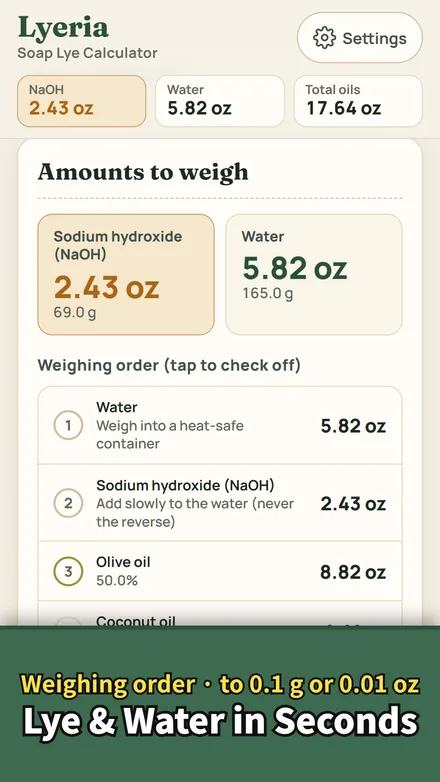
- Weighing order checklist: water, lye, then each oil; tap to check each one off.
- NaOH, KOH or dual lye with adjustable purity, superfat, fragrance, and water three ways (% of oils, lye concentration, water : lye ratio).
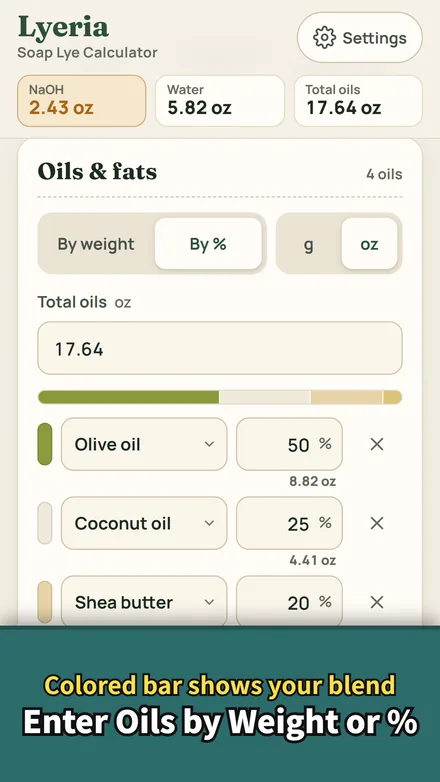
- Oils by weight or by percent, with a colored bar that shows your blend.
- Oil amount from your mold (box molds and round tubes).
- The real superfat when an oil's SAP value varies widely, as with shea butter above.
- Soap qualities and fatty acid profile as a guide, unlimited saved recipes, share as text, grams and centimeters or ounces and inches. No account, works offline.
- Lyeria Pro for soap sellers (one-time purchase): cost and suggested price per bar, ingredient labels with INCI names printed 8 per sheet as a PDF, a batch log, recipe cards with your logo, and no ads. Without Pro you keep calculating, saving and sharing as before.
The first screenshot at the bottom of this page is the 500 g recipe from this guide in ounces: NaOH 2.43 oz (69.0 g), water 5.82 oz (165.0 g), the same as the hand calculation above. The second is the same oils entered by percent. Get Lyeria free on Google Play (Android).
Frequently asked questions
How much lye do I need for 500 g of oil?
It depends on the oils. For 250 g olive, 125 g coconut, 100 g shea butter and 25 g castor oil, the oils take 72.61 g of NaOH, so at 5% superfat you weigh 69.0 g of NaOH. Multiply each oil's weight by its NaOH SAP value, add them up, and take off the superfat.
How do I convert a KOH SAP value to NaOH?
Multiply by 39.997 ÷ 56.106 and divide by 1000. Olive oil at 190 mg KOH/g is 0.1354 g of NaOH per g of oil.
What superfat should I use for soap?
Many cold-process recipes use about 5%, which is what this guide uses; follow the superfat your recipe gives. For the 500 g example, 0% is 72.61 g of NaOH and 5% is 69.0 g.
How much water do I need for cold process soap?
Recipes set it as a % of the oils, a lye concentration or a water : lye ratio. For 500 g of oils, 33% of the oils is 165.0 g of water; a 33% lye concentration is 140.0 g; a 2 : 1 ratio is 138.0 g.
How much KOH do I need for liquid soap?
Use the KOH SAP value ÷ 1000 for each oil, take off the superfat, then divide by the purity. For the 500 g example at 5% superfat, that is 96.8 g of pure KOH, or 107.5 g at 90% purity.
How much oil do I need for my soap mold?
Measure the inside of the mold. For a recipe with water at 33% of the oils, the oils are about 0.694 g per cm³ (0.40 oz per cubic inch), so a 20 × 8 × 7 cm mold takes 777 g of oils.
Is there a free app that calculates lye for soap?
Lyeria is a free Android app (with ads) that gives the NaOH, KOH and water for your oils, with superfat, purity, water three ways and a weighing-order checklist, in grams or ounces. It needs no account and works offline.
Before you make it. Results are a guide: oils vary by origin and harvest, and lye by purity. Wear gloves and eye protection, pour lye into water (never water into lye), work with ventilation, mix in stainless steel or PP rather than aluminum, keep children and pets away, rinse any splash on your skin with plenty of water, use 100% sodium or potassium hydroxide rather than drain cleaner, and check your recipe before you make it.