
Mix by parts: the easiest way to repeat a color
Polymer clay is easiest to mix in parts. Roll each clay into balls of the same size (a small round cutter or a clay ball sizer helps), count them out as the recipe says, then condition and blend until no streaks remain. Because every part is the same size, you can double or halve a recipe without changing the color.
When you need a set weight, such as 30 g for a project, divide the weight by the total number of parts. For 12 + 2 + 1 = 15 parts and 30 g, each part is 2 g.
What white, translucent, black and the opposite color do
- White lightens a color into a pastel. Clay colors are strong, so pastels often need several parts of white to one part of color.
- Translucent makes a color sheer without turning it chalky, like stained glass or jelly. A very small amount of color tints a lot of translucent clay.
- Black darkens and deepens. It is the strongest clay in most sets, so start with a speck.
- The opposite color (green for pink and red, blue for orange, purple for yellow) mutes a color into a softer, more natural shade while keeping more of its hue than black does.
To change the hue itself, mix neighboring colors: yellow and blue make green, red and yellow make orange, red and blue make purple. Every extra color in a mix makes it muddier, so try to reach your shade with two or three clays.
Polymer clay color mixing chart (starting ratios)
These are places to start. Pigment strength differs from brand to brand and color to color, so mix a small amount first and adjust.
Bake a test chip before a big batch
Some colors look slightly different after baking, and translucent clay clears and can darken a little. Before mixing a large amount, flatten a small piece, bake it at the temperature on the package, and compare it with your target. Keep the chip with the recipe written on the back.
How to make a Skinner blend
A Skinner blend is a smooth gradient from one clay color to another, made with a pasta machine. It is used for gradient beads, flower petals and ombre canes.
- Roll both colors into sheets of the same thickness and cut each into a right triangle of the same size.
- Put the two triangles together into a rectangle, so one color is thick where the other is thin.
- Fold the sheet in half bottom to top, keeping each color on its own side, and roll it through the machine with the fold first.
- Repeat folding the same way and rolling, usually 15 to 25 times, until the stripes melt into a smooth gradient.
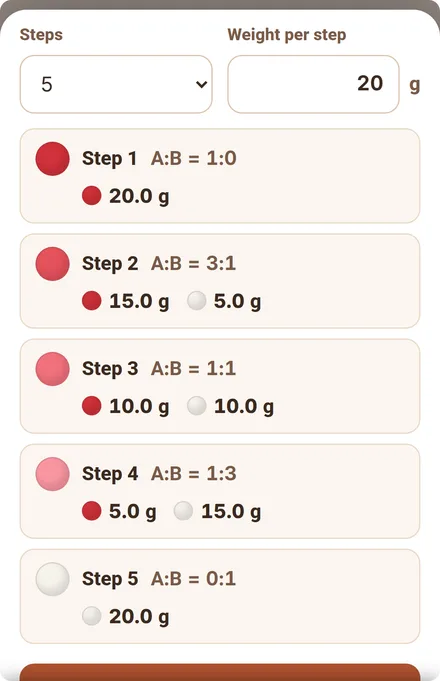
For a gradient made of separate colors, such as beads that step from red to white, mix each step from a set ratio instead: 1:0, 3:1, 1:1, 1:3, 0:1 for five steps.
Coloring air-dry resin clay with acrylic paint
White Japanese-style resin clay (air-dry) and other air-dry clays are often colored by kneading in acrylic paint. Add the paint a little at a time and knead until the color is even. Too much paint makes the clay sticky, so use less than you expect and let it rest if it gets soft.
Resin clay and most air-dry clays dry darker than they look while wet. Mix a little lighter than your target and dry a small test piece before you sculpt.
Get a recipe for a photo color from the clays you own
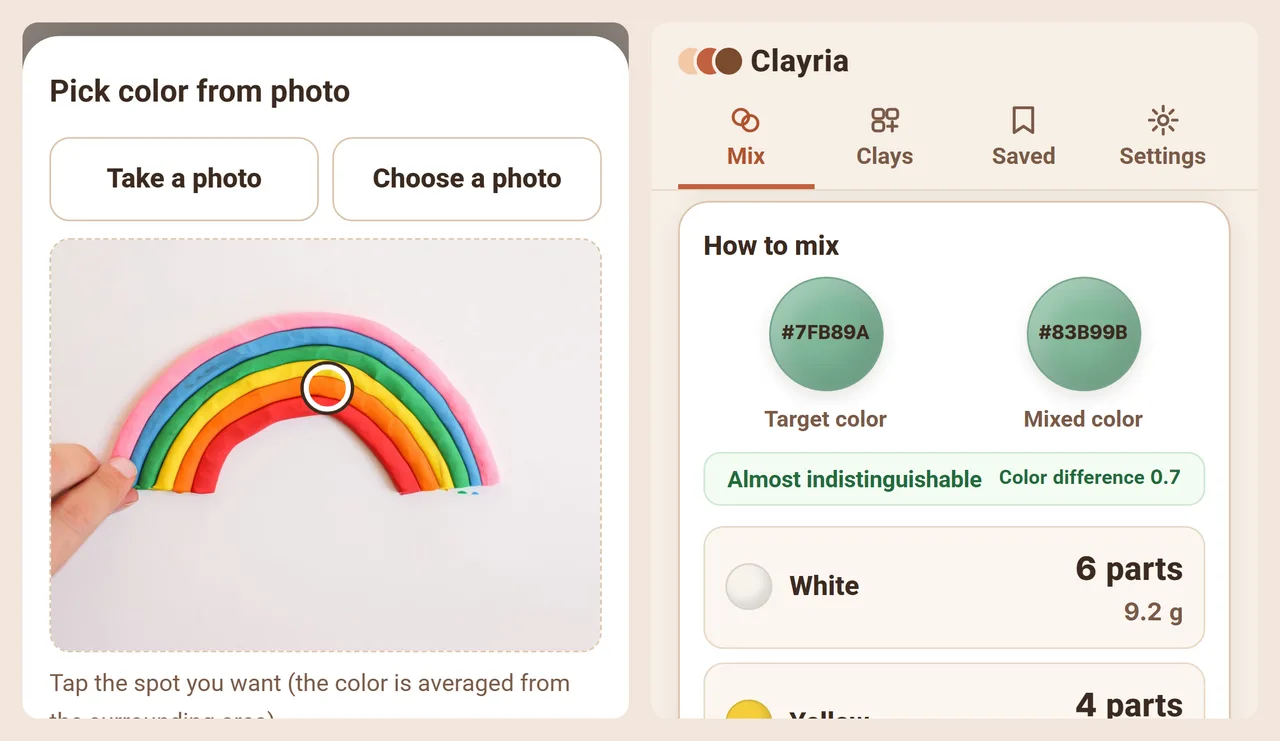
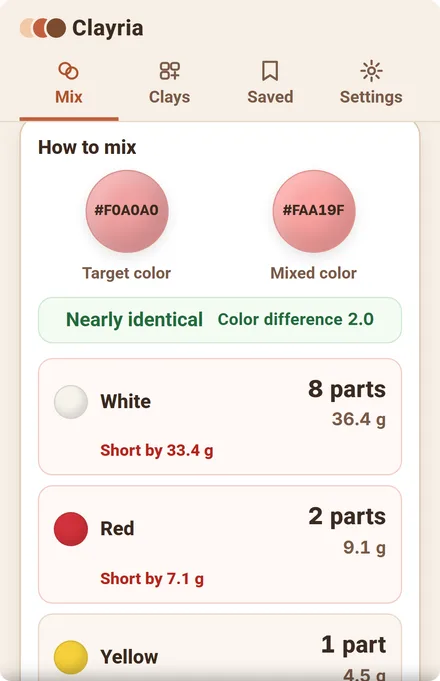
When you want to match a color from a photo or a HEX code, the Android app Clayria works out which of your clays to blend and how much. Pick the color and it shows the recipe in parts (equal-size balls) and in grams for the total weight you need, with your target and the predicted mix side by side.
- Choose your clays. Start from basic colors or brand color names as a guide, or add your own clay from a HEX code or a photo of your test chip. Mark translucent clays as sheer.
- Pick the target color by tapping a photo, using sliders, or typing a HEX code. Nudge it slightly darker or lighter if you like.
- Roll the parts shown and blend. Enter your stock in grams or pieces to see whether you have enough of each clay.
The app's predicted mix behaves like real clay: yellow and blue make green, and translucent, pearl and glitter clays soften a color rather than act like white. To color white air-dry resin clay with acrylic paint, add your paints as clays to see a starting ratio.
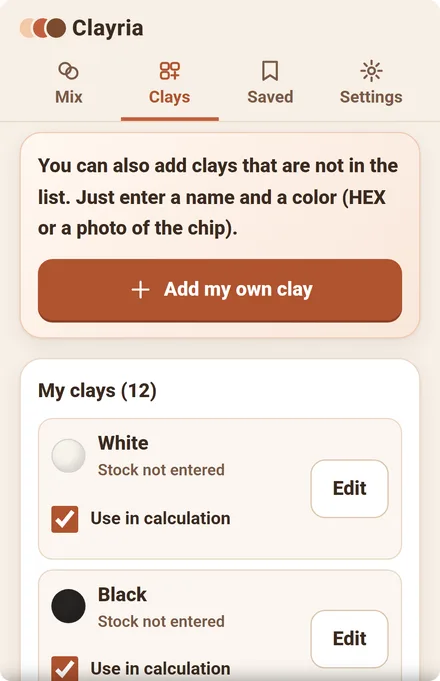
Color mixing is unlimited and free, and you can save up to 5 recipes. A one-time Pro upgrade adds unlimited saved recipes, Skinner blend recipes, backup for moving to a new phone, and recipe cards as an image or PDF.

FAQ
How do you mix polymer clay to match a color?
Measure each clay in parts by rolling equal-size balls, start with the lightest clay, and add strong colors a little at a time until a test chip matches (baked for polymer clay, dried for resin clay). The Android app Clayria shows the parts and grams of each clay you own for a color picked from a photo or a HEX code.
How do you make polymer clay lighter or more muted?
Add white to make a color lighter, or translucent to make it lighter and sheer. To mute it, add a speck of the opposite color (green for pink, blue for orange) or black, and bring it back with white if it gets too dark.
How do you make a Skinner blend?
Cut two clay sheets into matching triangles, put them together as a rectangle, then fold and roll the sheet through a pasta machine 15 to 25 times until it becomes a smooth gradient. For separate gradient colors, mix each step from a ratio such as 3:1, 1:1 and 1:3.
How do you color white air-dry resin clay with acrylic paint?
Knead in a small amount of acrylic paint and add more until the color is even, keeping the paint small so the clay does not get sticky. Resin clay dries darker, so mix slightly lighter than your target and dry a test piece.
How many grams of each clay do I need?
Divide the total weight by the total number of parts, then multiply by each clay's parts. For 30 g of a 12 : 2 : 1 recipe, each part is 2 g. Clayria shows the grams for any total weight you enter.
Does polymer clay change color when baked?
Some colors look slightly different after baking, and translucent clay clears and can darken a little. Bake a small test chip at the temperature on the package and compare it before you mix a large batch.
Is Clayria free?
It is free to download (in-app purchases). Color mixing with all your clays is unlimited and you can save up to 5 recipes for free. A one-time Pro upgrade adds unlimited recipes, Skinner blend recipes, backup and recipe cards. Your clays and recipes stay on your phone, and no account is needed.