The most common failure in a DIY shelf is sagging. What makes it hard to judge by feel is that the effect is non-linear. Adding 10 cm of span, or shaving 3 mm off the thickness, changes the result far more than intuition suggests.
This article covers the formula behind shelf sag, the reason online guides disagree on whether sag scales with span cubed or to the fourth power, and the part most guides leave out entirely: long-term sag (creep). All numbers here come from a real calculation engine.
The short answer: three rules
- The load you put on the shelf (a total weight) scales with span cubed
- The weight of the board itself scales with span to the fourth power
- Thickness works as the inverse cube (1/h³)
Double the span → sag from the load becomes 8×; sag from the board's own weight becomes 16×
Increase thickness 1.5× (18 → 27 mm) → sag drops to 0.30× (about 1/3.4)
Why so many guides say "fourth power"
For a simply supported board, textbooks give:
Uniform load: δ = 5wL⁴ / (384EI) Centre point load: δ = PL³ / (48EI)
Second moment of area: I = b·h³ / 12 (b = depth, h = thickness, in mm)
The detail that gets lost is what w means. It is not the total weight; it is the weight per unit length (N/mm).
When you design a shelf, you normally think in totals — "about 20 kg of books". If the total W is fixed, then w = W / L, and one L cancels out:
δ = 5wL⁴/(384EI) with w = W/L → δ = 5WL³/(384EI) = cubed
The board's own weight, by contrast, grows as the board gets longer, so w stays constant and the fourth power remains. Both answers are correct; they just assume different things are held constant. Since shelf planning starts from a total weight, cubed is the one that matches everyday experience.
🔴 We got this wrong ourselves. Takumia takes the load as a total weight, so cubed is correct — yet until 7 August 2026 our store description said "fourth power" in all eight languages, while the in-app help correctly said "cubed" from day one. The same product was saying opposite things in two places. Leaving out the assumption is all it takes.
Worked example: an MDF shelf 900 × 300 × 18 mm with 20 kg of books
| Item | Value |
|---|---|
| Second moment of area I | 145,800 mm⁴ |
| Weight of the board itself | 3.65 kg |
| Sag on day one | 5.03 mm (L/179) |
| Long-term sag | 16.35 mm (L/55) |
Five millimetres on day one is barely noticeable. 16.35 mm is not — on a 900 mm shelf that is a visible bow.
The part most guides skip: wood keeps sagging (creep)
The textbook formula gives the sag at the moment you load it. Wood-based materials under sustained load keep deforming over time. This is creep.
Eurocode 5 (EN 1995-1-1) quantifies it with a factor kdef. Final sag ≈ initial sag × (1 + kdef).
| Material | Service class 1 (heated indoor) | Service class 2 (damp but covered) |
|---|---|---|
| Solid timber / glulam | 1.60× | 1.80× |
| Plywood | 1.80× | 2.00× |
| OSB (OSB/3, OSB/4) | 2.50× | 3.25× |
| Particleboard (P5) | 3.25× | 4.00× |
| MDF | 3.25× | 4.00× |
The materials that are easiest to work with in DIY (MDF, particleboard) are the worst for creep. Solid timber settles at 1.60×; MDF reaches 3.25×. From the same starting sag, the end state differs by more than two to one.
The common reassurance that "real shelves are fixed at both ends, so calculating them as simply supported is conservative" does not hold on its own. The penalty from creep can outweigh the benefit from end fixity. We had written that reassurance into our own code comments and retracted it on 6 August 2026.
Do not mix service classes
kdef depends on how damp the location is.
- Service class 1 — heated indoor space: living-room bookcases, kitchen racks
- Service class 2 — covered but damp: garages, balconies, utility rooms, sheds
DIY shelves land in both, so you cannot pick one and forget it. We got this wrong twice. First we used a flat 1.5–2.0× for every material, which is well below the Eurocode 5 figures. Then we corrected MDF to 4.00× — but 4.00 is the service class 2 value, while every other material in the same table was still on service class 1. The numbers looked right, but the assumptions were mixed, which quietly breaks every comparison.
How much the material matters
Same 900 × 300 × 18 mm, same 20 kg, service class 1.
| Material | Young's modulus E | Initial sag | Long-term sag |
|---|---|---|---|
| Particleboard | 2,500 MPa | 5.98 mm | 19.42 mm (L/46) |
| MDF | 3,000 MPa | 5.03 mm | 16.35 mm (L/55) |
| Lauan plywood | 6,000 MPa | 2.41 mm | 4.34 mm (L/207) |
| SPF (solid) | 9,000 MPa | 1.57 mm | 2.52 mm (L/357) |
| Oak (solid) | 11,000 MPa | 1.37 mm | 2.20 mm (L/410) |
Long-term, MDF sags 6.5× more than solid SPF — the 3× difference in stiffness multiplied by the difference in creep (3.25× vs 1.60×).
Young's modulus figures are representative values. Even within one species, origin, moisture content and individual variation routinely shift them by ±20–30%. These numbers indicate how a shelf will behave; they are not a safety certification.
What to change first
- Shorten the span (cubed — by far the strongest lever)
- Increase thickness (also cubed)
- Change material (linear in E)
- Add an apron rail, back panel or cleat
The gap between the first two is clearer with numbers. Same MDF shelf, 20 kg:
| Change | Long-term sag |
|---|---|
| As built (900 mm span, 18 mm thick) | 16.35 mm (L/55) |
| Thickness → 21 mm | 10.56 mm (L/85) |
| Thickness → 24 mm | 7.25 mm (L/124) |
| Thickness → 30 mm | 3.90 mm (L/231) |
| Span → 600 mm (still 18 mm thick) | 4.60 mm (L/131) |
| Span → 400 mm (still 18 mm thick) | 1.31 mm (L/305) |
A 900 mm MDF span does not reach the target even at 30 mm thick. Adding one divider to halve the span costs less material and less work than thickening the board.
Reading "L/xxx"
Absolute sag in millimetres is not enough on its own: 5 mm over 900 mm and 5 mm over 300 mm mean different things. The usual measure is span divided by sag. Higher is straighter.
- L/300 or better — within the range commonly used as a deflection limit
- L/150 – L/300 — visibly sagging if you look
- Below L/150 — clearly bowed
There is no single official standard for DIY shelving. These bands are borrowed from deflection limits commonly used in building work, and what is acceptable depends on whether the shelf is decorative or purely functional.
The free app that does this for you
Every number above comes from the calculation engine of Takumia, an app I built. Enter dimensions, material, load and service class, and it returns initial sag, long-term sag, the L ratio, and the minimum thickness that meets your target.
It also covers cut optimisation (how many boards you need, where to cut, with a cut diagram), pilot holes and screw selection, weight, and mitre angles. It works offline and needs no account.
A free app for Android (Google Play). Works offline, no sign-up required.

Cut List & Shelf Sag: Takumia
Shelf sag, cut lists, pilot holes and screws, weight and mitre angles
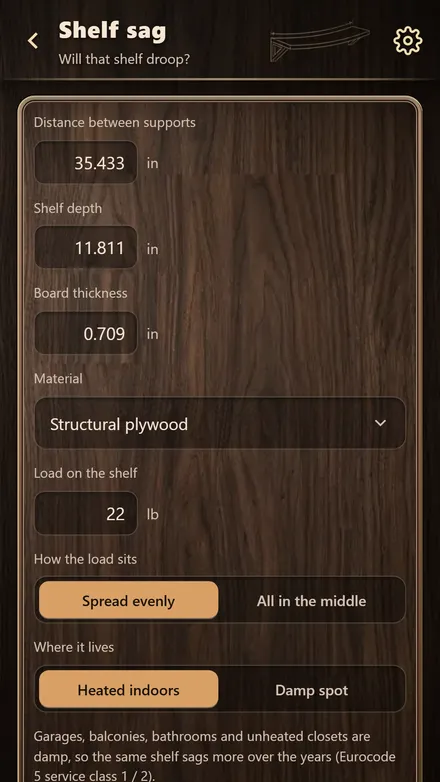


Free, works offline, no account needed. For Android.
Google Play and the Google Play logo are trademarks of Google LLC.
Summary
- Applied load scales with span cubed; the board's own weight with the fourth power; thickness as 1/h³
- Guides that say "fourth power" are not wrong — they hold weight per unit length constant
- What actually matters is long-term sag: MDF and particleboard reach 3.25–4.00× the initial value
- The easiest DIY materials are the weakest against creep
- The fastest fix is usually shortening the span, not thickening the board