The priority order, with the reason for each
- Evolution. Turning one weapon into its evolved form is the biggest single jump in power a run gives you. Take it the moment it appears.
- Level up a weapon you already own. Evolutions almost always require the weapon at max level.
- The passive that pairs with a weapon you own. That is the other half of the evolution condition. A max-level weapon without its partner never evolves.
- A new weapon — only if you have a free slot and you actually plan to take it all the way.
- Any other passive, chosen to fix what is hurting you: health or armor if you keep getting hit, pickup range if you keep missing XP.
- Healing or gold, once nothing else is left.
The most common beginner habit — grabbing every shiny new weapon — is exactly the one that delays evolutions the most. This applies to survivors-likes and "bullet heaven" games in general, not to one title.
Why fewer weapons win: the pick budget
Count how many picks one evolution costs. In our game, Cleanup Survivor, weapons max out at level 5, so one evolution takes:
- 1 pick to get the weapon
- 4 picks to take it to level 5
- 1 pick for its paired passive
- 1 pick for the evolution itself
That is 7 picks per evolution — or 6 for the weapon you start with.
Picks, on the other hand, arrive slowly. Over 20 automated runs of Dirty Town, the median level was 6 at one minute, 11 at two and 15 at three. The mini-boss showed up at a median of 158 seconds, at level 13. That is about 12 picks before the mini-boss: even if every one of them went into evolutions, you could have at most 1 by then (6 picks for your starting weapon, 7 more for the next). Each pick spent on a new weapon moves your first evolution one pick further away.
Late in a run the picture changes: cleared runs ended around level 50, so picks become plentiful later on. What differs is when you get strong. In the comparison below, the focused rule reached its first evolution at a median of 227 seconds, about a minute after the mini-boss appeared; the spread rule took 436 seconds, more than four minutes after the mini-boss. The numbers change from game to game; the reasoning carries over.
We tested it: three pick rules, 20 runs each
To check this with more than arithmetic, we ran the actual game code of Cleanup Survivor with the same automated player (it keeps away from enemies and circles to collect XP) and changed only how it picks at level-up. Each rule played two stages 20 times, with the same random seeds for all three rules, no permanent upgrades, gear, pets or revives, and the tool pool fixed at 10 tools (roughly a player a few stages in; a brand-new player sees fewer tools, which makes spreading cost less).
- Focus: the order in this guide (evolution → owned weapon → paired passive → new weapon → other passive)
- Spread: take anything new first
- Random: pick one of the three cards at random
Dirty Town (stage 2)
| Rule | Cleared | 1st evolution | Evolutions |
|---|---|---|---|
| Focus | 15/20 | 227s | 3.85 |
| Spread | 13/20 | 436s | 2.25 |
| Random | 11/20 | 450s | 1.75 |
Trashy Park (stage 4)
| Rule | Cleared | 1st evolution | Evolutions |
|---|---|---|---|
| Focus | 5/20 | 177s | 1.65 |
| Spread | 5/20 | 300s | 0.90 |
| Random | 1/20 | 294s | 0.15 |
On Dirty Town, focusing brought the first evolution at a median of 227 seconds — roughly half the time of spreading (436) or random picks (450) — and averaged 3.85 evolutions per run. Clears were 15, 13 and 11 of 20 — a gap of two runs, too small on its own to call one rule safer. Trashy Park was hard for this automated player: focus and spread both cleared 5 of 20, so no difference there. Even so, focusing again evolved sooner (177 vs 300 seconds) and more often (1.65 vs 0.90 evolutions), and random picks cleared only once. The pick rule alone does not decide a run, but it clearly changes when you get strong.
"1st evolution" is the median in-game clock time in seconds (runs that ended before any evolution are left out); "Evolutions" is the average per run. This is a comparison between automated players, not human play, and the numbers will move as the game is tuned.
Evolutions work the same way almost everywhere
The details vary, but the preparation does not. In Vampire Survivors, for example, a weapon evolves when you open a treasure chest while holding the weapon at max level and its required passive item. In other games the evolution simply shows up as a level-up option once the conditions are met.
The annoying part is remembering which passive pairs with which weapon — which is why so many players keep an evolution chart open in another tab. Cleanup Survivor prints the pairing on the card instead.
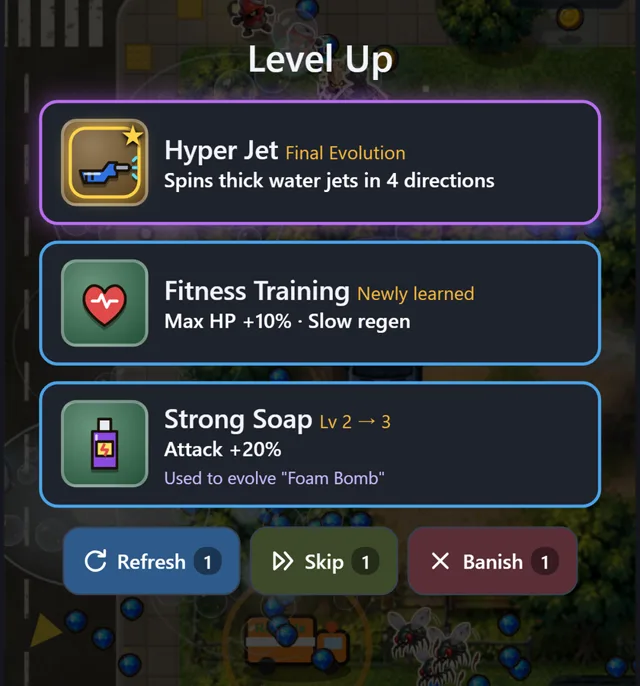
- A passive that pairs with one of your tools says so, for example "Used to evolve 'Foam Bomb'".
- Weapon cards show the full recipe: level 5, plus which passive, turns into which evolution.
- The pause screen lists each weapon you hold, what it needs to evolve, and what it becomes.
The passive only has to be in your build at level 1. And when an evolution is ready, it is always one of the three cards, so you never miss it to bad luck (chests can evolve weapons too).
When to use Refresh, Skip and Banish
Most survivors-likes give you some way to redraw or remove cards. The names differ; the jobs are the same.
- Refresh (reroll): redraw all three cards. Use it when none of them helps the weapons you are evolving.
- Skip: take nothing. Use it when every card would fill a slot with something you do not want.
- Banish: remove that option for the rest of the run. Banish weapons you will never evolve, and later cards lean toward the ones you will.
Banish is the strongest of the three. Cards are drawn from a pool that includes weapons you do not own yet, so every unwanted weapon you remove makes the ones you want more likely. In Cleanup Survivor you start each run with one of each, and Power Up upgrades outside the run add more.
How to move
- Keep moving. Standing still lets enemies close in from every side. Circle around the edge of the horde.
- Collecting XP is part of moving. Every gem you leave behind is a pick you never get.
- Strong enemies are worth hunting. In many games they drop chests, and a chest is several picks at once. In Cleanup Survivor, mini-bosses and tough enemies drop treasure chests.
Trying it in Cleanup Survivor
Cleanup Survivor is our survivors-like: trash monsters come at you in hordes, and you sweep them away with cleaning tools. Attacking is automatic — you just drag to walk, and everywhere you walk gets clean again.
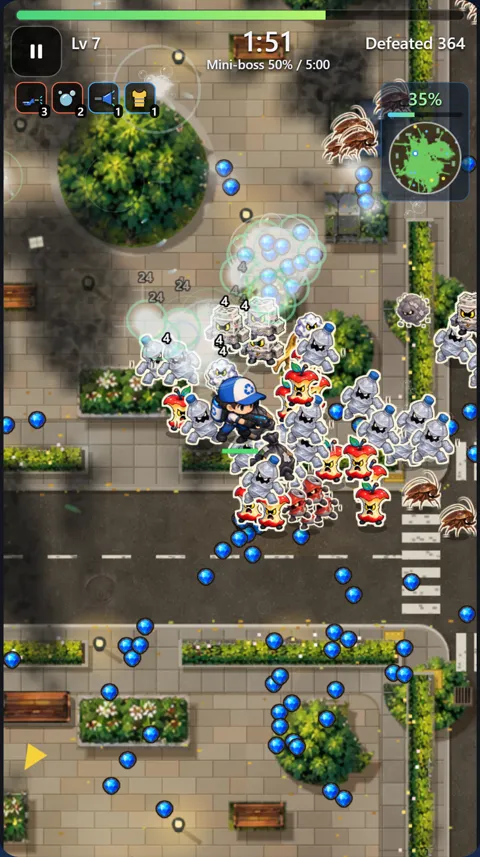
The order in this guide is the same order the game's "Take all (auto)" button uses. It appears when three or more level-ups stack up, and it picks for you in this order: evolution → level a tool you own → its paired passive → a new tool → other passives → healing or coins. If you are unsure, press it and look at what it chose.
- 30 cleaning tools, each with its own evolution
- On your very first run, the first minute or so has fewer enemies and you take less damage
- Available in 8 languages, including English and Japanese
Summary
- When in doubt: evolution → level what you own → its paired passive.
- Take a new weapon only with a free slot and a plan to finish it.
- You get few picks before the first tough enemy, so choose your evolutions early and feed them.
- Banish weapons you will not evolve.
- Keep moving, and treat XP as part of your route.
FAQ
What should I upgrade first in a survivors-like game?
Level up the weapon you start with. In most survivors-likes an evolution needs the weapon at max level, so taking one weapon to max first and then grabbing its paired passive brings your first evolution much sooner.
How many weapons should I carry?
Early on, only as many as you can take all the way to evolution. In Cleanup Survivor one evolution costs 7 picks, and an automated player had about 12 picks before the first mini-boss appeared. Focus on evolving one weapon first and add new ones afterwards, and your first evolution comes much sooner.
How do weapon evolutions work in survivor games?
In most survivors-likes a weapon evolves when it is at max level and you also hold a specific passive item. Some games trigger the evolution when you open a treasure chest; others offer it as a level-up choice. In Cleanup Survivor the weapon needs level 5 plus its paired passive, and a ready evolution always appears among the three level-up cards.
Related
- All GRAMSHIFT guides
- Cleanup Survivor on Google Play
- What is an idle RPG? — another auto-battle genre, explained
Also in Japanese
This guide is also available in Japanese: サバイバー系ゲームのコツ(日本語版).