How to Pick a Free Brain Puzzle Game
— Sudoku, nonogram and mahjong solitaire actually use your brain in different ways —
The short answer: choose a free puzzle by the kind of thinking you want, not by difficulty. Numbers and quiet focus? Sudoku. The satisfaction of a picture completing? Nonogram. Quick, satisfying clears? Mahjong solitaire. Below, we — a studio that actually builds these puzzles (GramShift) — walk through the differences and how to avoid a badly-made one.


Quick pick: choose by mood
| When you feel like… | Best genre | Our free app |
|---|---|---|
| Quiet focus with numbers | Sudoku | Sudoria |
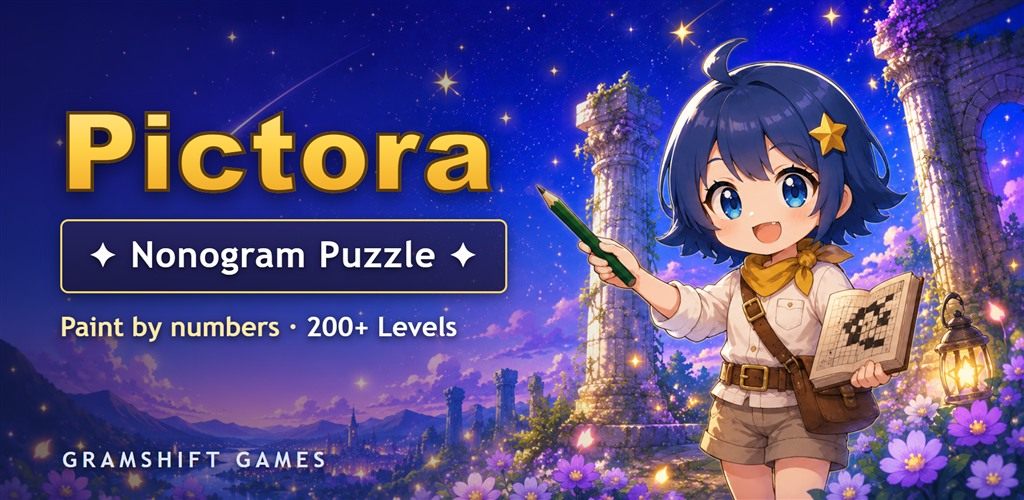
| The joy of a picture completing | Nonogram (Picross) | Pictora |
| Quick, satisfying clears | Mahjong solitaire | Majoria |
| Place, fill and clear at your own pace | Block puzzle (9×9) | Temple Quest |
| Carve the grid into the one right set of rectangles | Shikaku | SHIKAcookie |
| Tense, pure-logic deduction | Minesweeper | Mineria (coming) |
1. Sudoku — quiet focus with numbers
How it feels: Fill a 9×9 grid with 1–9 so no number repeats in any row, column or 3×3 box. It is less about flashes of insight and more about stacking one certainty on another. Great when you want to switch off the music and concentrate.
A good sudoku app only serves puzzles with exactly one solution. Cheap apps mix in flawed puzzles with multiple answers, which feel unsatisfying. We machine-verify every puzzle for a unique solution before it ships.
→ Our free sudoku: Sudoria (how to play & solving tips)
2. Nonogram (Picross) — a picture appears as you solve
How it feels: Use number clues to fill cells, and a picture emerges when you finish. If sudoku is the joy of "locking in," nonogram is the joy of "completing." It is collectible — you want to fill the gallery.
The quality of the pictures is the whole point. A finished image should clearly be something — cute and recognizable. Noise-like art with no payoff gets old fast.
→ Our free nonogram: Pictora (how to play)
3. Mahjong solitaire — quick, satisfying clears
How it feels: Remove matching pairs of free tiles from a stacked layout. Instantly understandable, short rounds — perfect for a spare minute.
Mahjong solitaire can dead-end depending on how the tiles were dealt. Apps that stack tiles randomly can leave you stuck through no fault of your own. A good one guarantees a layout that can always be cleared. Our Majoria deals only solvable layouts and stays solvable after a shuffle. Not being trapped by luck is a matter of respect for the player.
→ Our free mahjong solitaire: Majoria (how to play)
4. Block puzzle (9×9) — place, fill, clear
How it feels: You are given three pieces at a time and drop them onto a 9×9 board. Fill a row, a column or a 3×3 box and it clears. Nothing falls on a timer, so you can think for as long as you like — it works for a one-minute break and for a long sitting.
Is it beginner friendly? The rules are only "place a piece" and "a full line clears". The skill that makes you better is keeping open space so the next three pieces always fit somewhere.
In this genre it is easy to reach a board where none of the three pieces fit anywhere — through no fault of your own. Losing to the deal rather than to your own reading is not a puzzle, it is just frustration. Our Temple Quest ships 200 stages that are all confirmed clearable. Same promise as everywhere else: you never lose to luck.
→ Our free block puzzle: Temple Quest (tips & how to play)
5. Shikaku — divide the grid into rectangles
How it feels: Split the whole board into rectangles so that each one contains exactly one number, and that number is how many cells the rectangle covers. That is the entire rule. From there it is a chain of "this can only be cut one way" — closer to reading a shape than to arithmetic, and the finished board is a picture in itself.
Is it beginner friendly? Yes. Start from the numbers in the corners and the small numbers like 2 and 3: they have the fewest possible placements, so they settle themselves. Then work outward from what you just fixed.
In this genre it is common to hit a board that runs on logic most of the way and then asks you to brute-force the last step. Guessing right is not satisfying. Our SHIKAcookie ships 486 levels that are all machine-verified to be solvable by logic alone, and its hints give you the reason a cell is forced rather than the answer.
→ Our free shikaku: SHIKAcookie (how to solve it)
6. Minesweeper — tense logic (coming soon)
Minesweeper is a classic of pure deduction, but old versions left the infamous "50/50 guess" at the end. We build only boards that are solvable with no guessing (No-Guess) — Mineria (coming).
What we hold to in every game
- Never trapped by luck (unique solution / guaranteed-solvable / No-Guess). An unfair dead-end is stress, not a puzzle.
- A real range of difficulty, from first-timer to brutal, in one app.
- Quiet, focused play: ads never sit where they get in the way. We don't hold the fun hostage.
FAQ
- Q. Are these games completely free?
- Yes. The games here are free to play. A few moments (like a continue) may offer an optional "watch a video or share" choice, but playing itself costs nothing.
- Q. Can I play offline?
- Sudoku, nonogram and most others play offline (details on each game's page).
- Q. Which should I start with?
- Use the "choose by mood" table above. If you like numbers, Sudoria; pictures, Pictora; quick clears, Majoria; no guessing ever, SHIKAcookie.
- Q. Is there language support beyond English?
- Yes — Japanese, Spanish, Portuguese, French, German, Korean and Chinese are supported.
The puzzles (free to play)
- Sudoria — SudokuFree · Play
- Pictora — NonogramFree · Play
- Majoria — Mahjong solitaireFree · Play
- Temple Quest — Block puzzle (9×9)Free · Play
- SHIKAcookie — ShikakuFree · Play
- Mineria / Star Battle — logic puzzlesComing